
CSA vs FedRAMP
CSA
Canadian consensus standards for OHS management and hazard control
FedRAMP
U.S. program standardizing federal cloud security assessments.
Quick Verdict
CSA offers voluntary occupational health and safety standards for broad industries, enabling compliance and certification. FedRAMP mandates rigorous cloud security assessments for US federal agencies via 3PAO audits. Companies adopt CSA for risk management; FedRAMP unlocks federal contracts.
CSA
CSA Z1000 Occupational Health and Safety Management
Key Features
- Consensus-based development overseen by Standards Council of Canada
- PDCA-based OHS management system framework (Z1000)
- Structured hazard identification across six categories (Z1002)
- Hierarchy of controls prioritizing elimination and engineering
- Integral worker participation and leadership commitment
FedRAMP
Federal Risk and Authorization Management Program
Key Features
- Reusable authorizations across federal agencies
- NIST SP 800-53 baselines by impact levels
- Independent 3PAO security assessments
- Continuous monitoring with automation focus
- FedRAMP Marketplace for transparency
Detailed Analysis
A comprehensive look at the specific requirements, scope, and impact of each standard.
CSA Details
What It Is
CSA standards, developed by CSA Group, are a family of consensus-based National Standards of Canada for occupational health and safety (OHS), with CSA Z1000 providing an OHS management system (OHSMS) and CSA Z1002 focusing on hazard identification and risk control. They are voluntary frameworks that gain legal force when incorporated by reference into regulations, using a risk-based Plan-Do-Check-Act (PDCA) methodology aligned with ISO 45001.
Key Components
- Leadership commitment, planning, implementation, checking (monitoring, audits), and management review (Z1000 PDCA structure).
- Hazard classification (biological, chemical, ergonomic, physical, psychosocial, safety), risk prioritization, hierarchy of controls (Z1002).
- Worker participation, training, incident investigation, continual improvement. Compliance via self-assessment or SCC-accredited third-party certification.
Why Organizations Use It
Demonstrates due diligence, meets regulatory references, reduces incidents and liability. Enhances safety culture, operational efficiency, market access; builds regulator, worker, and stakeholder trust.
Implementation Overview
Phased approach: gap analysis, policy integration, training, audits, reviews. Suits all industries/sizes in Canada and aligned markets; 12-18 months typical, with optional certification.
FedRAMP Details
What It Is
FedRAMP (Federal Risk and Authorization Management Program) is a U.S. government framework standardizing security assessment, authorization, and continuous monitoring for cloud services used by federal agencies. Its purpose is accelerating secure cloud adoption via reusable authorizations, reducing duplication. It uses a risk-based, control-oriented approach derived from NIST SP 800-53 controls mapped to FIPS 199 impact levels (Low, Moderate, High).
Key Components
- Security baselines: Low (~156 controls), Moderate (~323), High (~410), plus LI-SaaS for low-risk SaaS
- Core artifacts: System Security Plan (SSP), Security Assessment Report (SAR), Plan of Action & Milestones (POA&M)
- Built on NIST SP 800-53 Rev 5 with FedRAMP overlays
- Compliance model: 3PAO independent assessments and ongoing monitoring
Why Organizations Use It
- De facto mandatory for CSPs targeting federal contracts
- Enhances risk management and security posture
- Provides competitive edge via Marketplace credibility
- Builds trust with agencies, enables multi-agency reuse
Implementation Overview
- Phased: gap analysis, documentation, 3PAO assessment, remediation, authorization
- Targets cloud service providers (CSPs) for U.S. federal market
- Involves heavy documentation, audits by accredited 3PAOs
- Typical timeline: 10-19 months, high costs ($150k-$2M+)
Key Differences
| Aspect | CSA | FedRAMP |
|---|---|---|
| Scope | Safety mgmt, OHS, software assurance | Cloud security assessment, monitoring |
| Industry | All sectors, Canada/global focus | US federal cloud providers |
| Nature | Voluntary standards/certification | Mandatory for federal cloud use |
| Testing | Audits, certifications by bodies | 3PAO assessments, continuous monitoring |
| Penalties | Loss of certification, due diligence risk | Revocation, contract ineligibility |
Scope
Industry
Nature
Testing
Penalties
Frequently Asked Questions
Common questions about CSA and FedRAMP
CSA FAQ
FedRAMP FAQ
You Might also be Interested in These Articles...
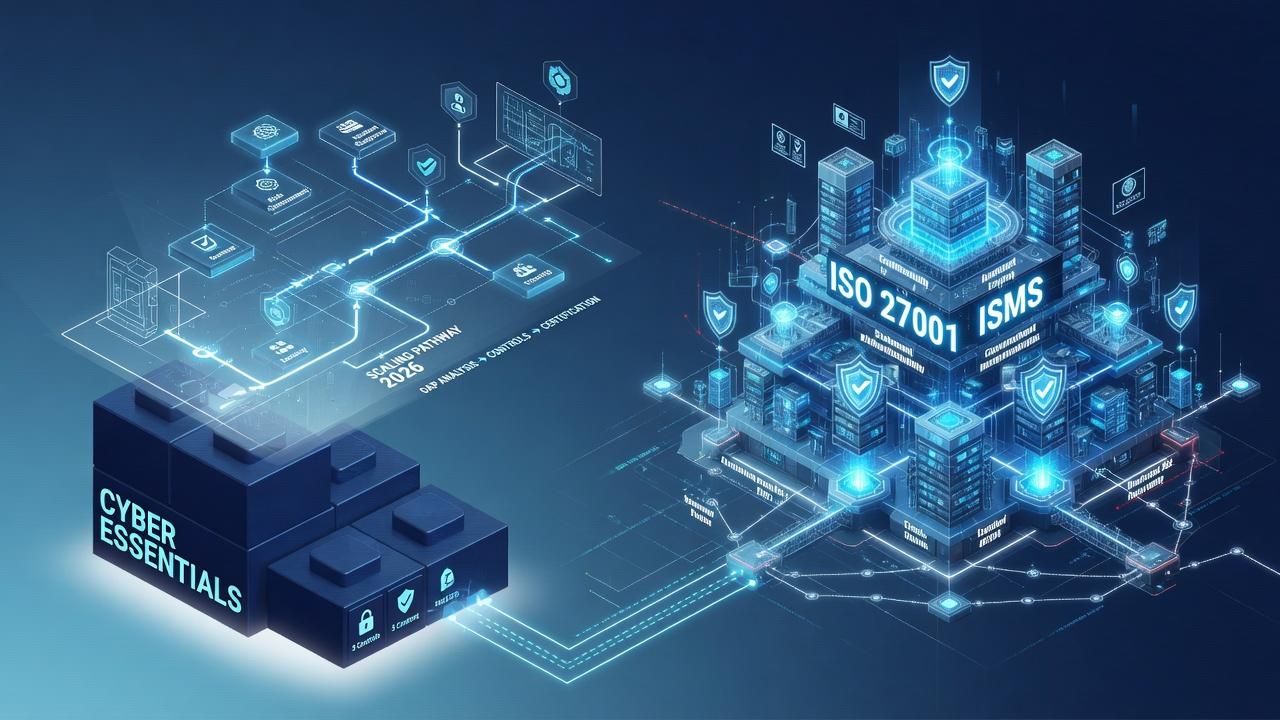
From Hygiene to Governance: How to Scale Cyber Essentials into a Full ISO 27001 ISMS in 2026
Discover how to scale Cyber Essentials into a full ISO 27001 ISMS in 2026. Reuse evidence, map controls, meet DORA & NIS2 rules and win enterprise contracts.

NIST CSF 2.0 Deep Dive: Mastering the Updated Framework Core Functions
Unpack NIST CSF 2.0's enhanced Core Functions: Govern, Identify, Protect, Detect, Respond, Recover. Get SME playbooks, governance shifts & strategies for cyber

You Guide on how to Start Implementing NIS2 in Your Organization
Master NIS2 implementation with our detailed guide. Learn requirements, risk assessment, supply chain security, and compliance steps for your organization. Star
Run Maturity Assessments with GRADUM
Transform your compliance journey with our AI-powered assessment platform
Assess your organization's maturity across multiple standards and regulations including ISO 27001, DORA, NIS2, NIST, GDPR, and hundreds more. Get actionable insights and track your progress with collaborative, AI-powered evaluations.
Explore More Comparisons
See how CSA and FedRAMP compare against other standards