
From Hygiene to Governance: How to Scale Cyber Essentials into a Full ISO 27001 ISMS in 2026
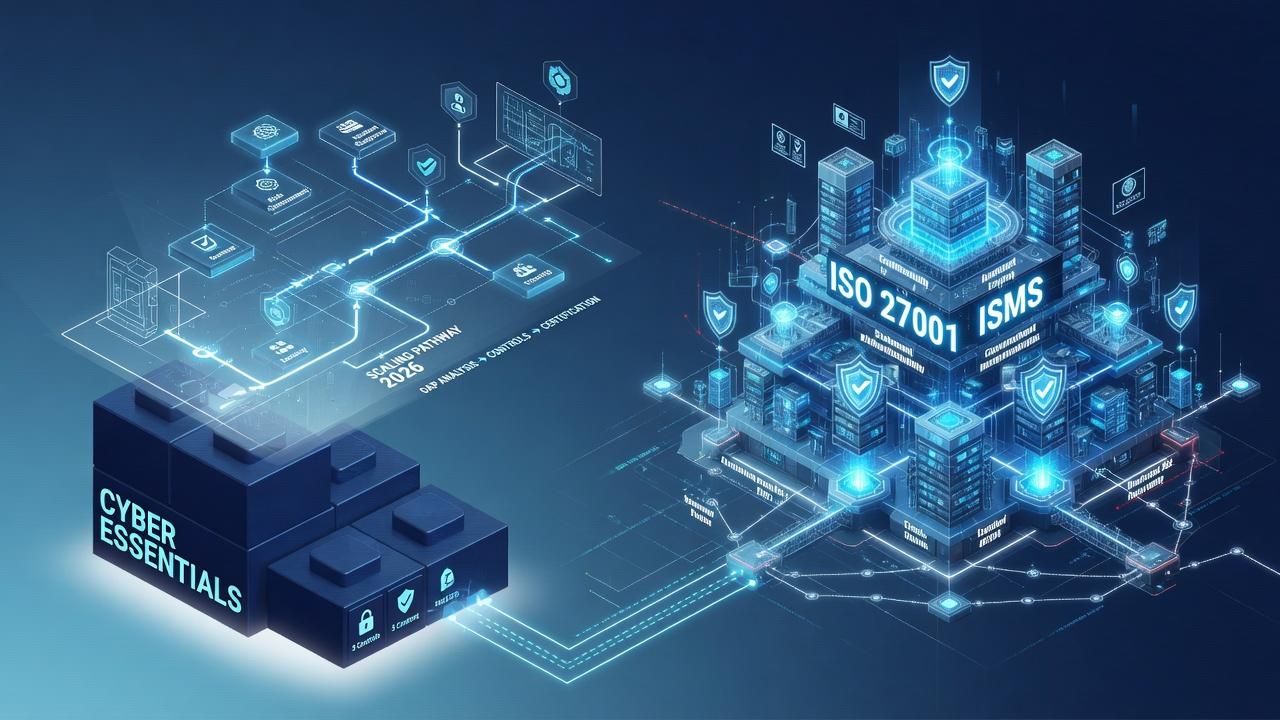
From a Failed Tender to Enterprise-Ready Resilience
Opening Hook
A UK SaaS provider submitted its Cyber Essentials Plus certificate for a €4 million financial services contract in March 2026.
The buyer’s due-diligence team ran a live vulnerability scan and discovered unpatched endpoints plus missing board-level incident reporting. The deal collapsed in 48 hours.
Three months later the same company passed its ISO 27001 Stage 2 audit and won two larger contracts.
The difference was not new technology; it was the deliberate scaling of five hygiene controls into a governed Information Security Management System.
What You'll Learn
- How Cyber Essentials and ISO 27001 overlap on up to 60 % of controls, creating a fast on-ramp
- The exact regulatory triggers in 2026 (DORA, NIS2, UK public procurement) that make scaling non-negotiable
- A repeatable six-step gap-analysis and mapping process that eliminates duplicate work
- Governance changes required when boards become personally accountable for ICT risk
- Practical tooling, cost ranges, and timelines realistic for mid-market teams
- The single mindset shift that separates organisations that maintain certification from those that merely renew it
Cyber Essentials and ISO 27001: Complementary, Not Competing
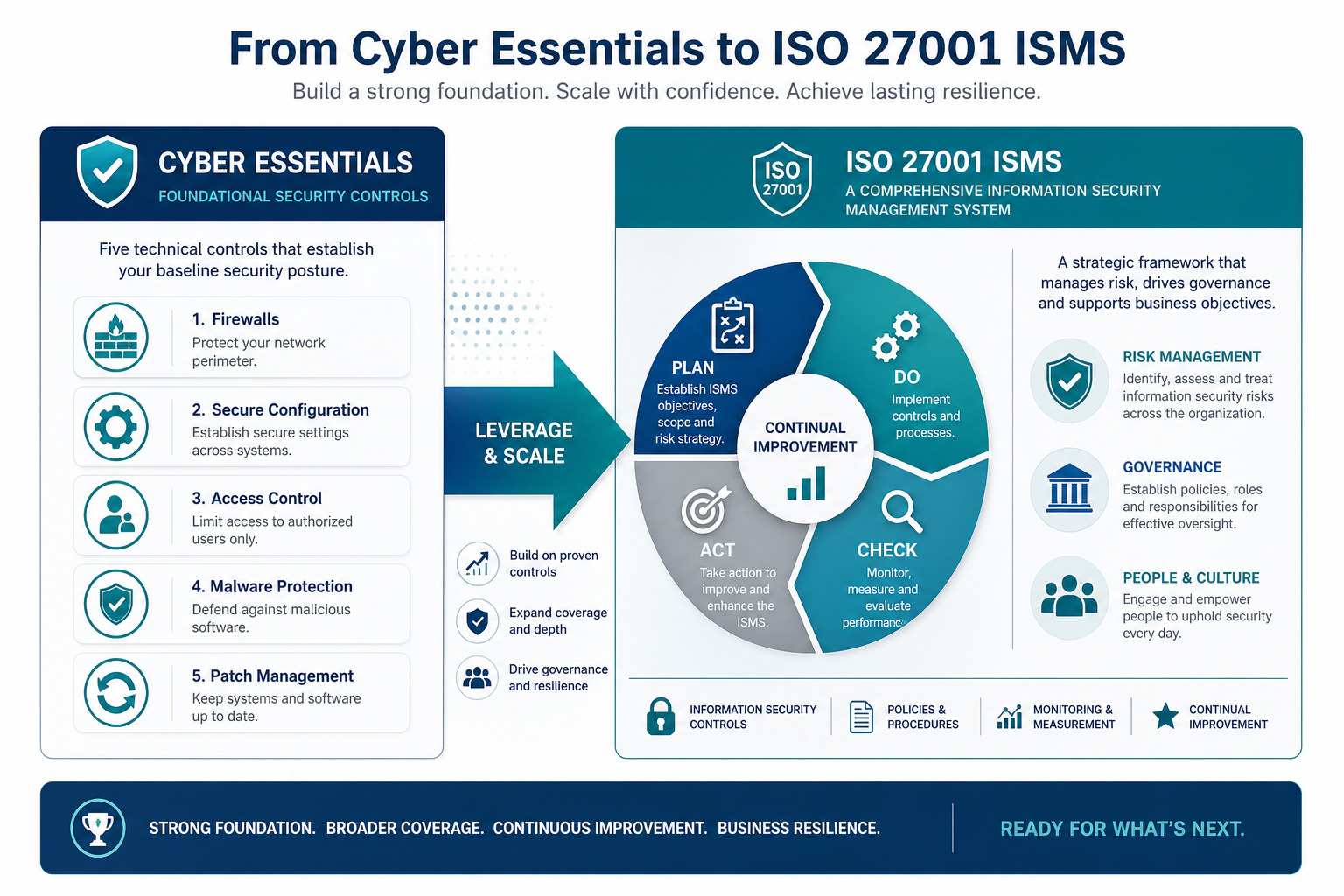
Cyber Essentials validates five technical controls—boundary firewalls, secure configuration, user access control, malware protection, and patch management—through a point-in-time assessment.
ISO 27001:2022 requires an organisation to define scope, conduct risk assessment, select controls from a catalogue of 93 Annex A items, and operate a continual improvement cycle under Clause 9.
The frameworks are not rivals. The five Cyber Essentials controls map directly to multiple Annex A statements (A.5.15–A.5.18, A.8.7–A.8.8, A.8.20–A.8.23).
Organisations that already operate the hygiene baseline therefore satisfy roughly 60 % of the technical layer before they begin policy work.
Pro Tip
Run a quick control crosswalk before any consultancy engagement.
A single spreadsheet listing the five Cyber Essentials controls against Annex A 2022 clauses reveals exactly which policies and procedures are still missing.
2026 Regulatory Drivers That Force the Next Step
DORA (EU Regulation 2022/2554) has been fully enforced since January 2025. It consolidates fragmented financial-sector ICT rules and adds explicit board accountability, 24-hour major-incident notification, and third-party risk registers.
NIS2 expands similar obligations to additional critical sectors. UK public-sector tenders continue to require Cyber Essentials Plus, yet enterprise and cross-border buyers now expect ISO 27001.
SMEs that treat Cyber Essentials as an endpoint face two concrete risks: loss of contract eligibility once buyers demand operational-resilience evidence, and personal liability exposure for directors under DORA-style governance clauses.
Scaling is therefore a commercial and regulatory necessity rather than a voluntary maturity exercise.
Key Takeaway
In June 2026 the market no longer rewards “we have basic hygiene.”
It rewards demonstrable governance that survives both technical testing and board-level scrutiny.
Performing a Structured Gap Analysis
Begin with a one-page mapping template that lists every Cyber Essentials control, its current evidence artefacts, and the corresponding ISO 27001 Annex A and Clause references.
Add DORA articles 9–12 and 28–30 for vendor and incident management.
Next, run an internal scan using the same criteria an accredited assessor would apply: credentialed vulnerability scanning of 20 % of endpoints, verification that CVSS 7.0+ issues are remediated within 14 days, and confirmation that multi-factor authentication is enforced on all cloud administrative accounts.
Document every gap as a risk entry with owner, likelihood, impact, and treatment plan.
This single artefact becomes the backbone of both the ISO 27001 risk register and the DORA ICT risk management framework.
Mini-checklist
- Export current Cyber Essentials questionnaire answers
- Map each answer to Annex A 2022 controls
- Identify missing policies (asset management, supplier due diligence, business continuity)
- Record evidence locations (logs, tickets, approval trails)
- Assign owners and deadlines before external audit booking
Evolving Governance from Hygiene to Accountability
ISO 27001 Clause 5 requires top management to demonstrate leadership and commitment.
DORA goes further by placing personal accountability on the governing board for ICT risk oversight.
The practical translation is a quarterly board dashboard that reports residual risk, open exceptions, and incident trends rather than a once-a-year policy sign-off.
Segregation of duties matrices, exception registers, and timestamped approval workflows replace tribal knowledge.
Auditors in 2026 routinely reject static policy documents that do not connect to live system logs.
Key Takeaway
The decisive shift is not writing more policies; it is ensuring every policy is executed, logged, and reviewed by someone who cannot also perform the action.
Implementation Roadmap and Realistic Costs
Organisations that already hold Cyber Essentials Plus typically complete ISO 27001 certification in four to seven months when they reuse existing technical evidence.
- Months 1–2: Scope definition, risk assessment, Statement of Applicability, and gap remediation
- Months 3–4: Policy and procedure rollout using editable templates mapped to multiple frameworks
- Month 5: Internal audit and management review
- Month 6–7: Stage 1 and Stage 2 certification audits
Budget ranges in June 2026 remain stable: Cyber Essentials Plus renewal £1 500–£4 500; ISO 27001 implementation and first-cycle audit £15 000–£45 000 for organisations under 250 staff.
Automation platforms that map controls across ISO 27001, SOC 2, and DORA reduce documentation effort by 40–60 %.
Pro Tip
Purchase the official ISO/IEC 27001:2022 standard once.
Use free crosswalk resources such as the Cloud Security Alliance Cloud Controls Matrix only for initial orientation, never for audit evidence.
The Counter-Intuitive Lesson Most People Miss
Most teams assume that adding technical depth or purchasing more templates will close governance gaps.
In reality, the organisations that sustain both certifications treat ISO 27001 as an operating system, not a project.
They embed risk decisions into change-management workflows, procurement gates, and product roadmaps so that the management system runs itself.
Certifications then become the annual confirmation of an already-functioning discipline rather than a frantic scramble every twelve or thirty-six months.
Glossary: Key Terms Mini-Glossary
- Cyber Essentials — NCSC-backed scheme verifying five technical controls against common internet threats.
- Cyber Essentials Plus — Independent hands-on technical audit of the same five controls plus vulnerability testing.
- ISO 27001:2022 — International standard for establishing and continually improving an Information Security Management System.
- ISMS — Information Security Management System: the policies, processes, and controls governed by ISO 27001.
- DORA — EU Digital Operational Resilience Act requiring financial entities to manage ICT risk with board accountability.
- Annex A Controls — 93 security controls in ISO 27001:2022 grouped into organisational, people, physical, and technological domains.
- Statement of Applicability — Document listing which Annex A controls are applicable and how they are implemented.
- Clause 9 — ISO 27001 section mandating performance evaluation through monitoring, internal audits, and management review.
- Segregation of Duties — Control ensuring no single individual can complete a critical process end-to-end.
- Third-Party Risk Management — Structured assessment and monitoring of vendors mapped to DORA Articles 28–30 and ISO 27001 A.5.19–A.5.22.
- Point-in-Time Assessment — Certification that validates controls only at the moment of audit, requiring continuous operation thereafter.
FAQ
Does holding ISO 27001 automatically satisfy Cyber Essentials?
No. The standards remain separate, yet the technical controls implemented for ISO 27001 usually satisfy Cyber Essentials with minimal extra work.
How long does the full journey take for a 100-person company?
Four to seven months when Cyber Essentials Plus evidence is reused and templates are pre-mapped.
Is board liability under DORA materially different from ISO 27001?
Yes. ISO 27001 requires top-management support; DORA places personal accountability on the governing board for ICT resilience.
Can SMEs afford both certifications?
Yes. Sequential adoption—Cyber Essentials Plus first, then ISO 27001—keeps total first-year cost under £50 000 for most mid-market organisations.
What happens if a control fails during a CE+ audit?
Critical vulnerabilities (CVSS 7.0+) must be remediated within 14 days; otherwise certification is withheld until re-testing.
Do automation platforms replace the need for internal expertise?
They reduce documentation volume but cannot substitute for risk-based decisions or evidence that controls operate daily.
How often must each certification be renewed?
Cyber Essentials Plus requires annual re-assessment; ISO 27001 follows a three-year cycle with annual surveillance audits.
Which framework should a UK public-sector supplier pursue first?
Cyber Essentials Plus remains the mandatory entry ticket; ISO 27001 becomes essential once enterprise or cross-border contracts appear.
Conclusion: Closing the Loop
The company that lost the financial services contract did not buy new firewalls.
It mapped its existing five controls into a governed ISMS, introduced board risk reporting, and aligned the same artefacts to DORA requirements.
Six months later it held both certifications and two new contracts.
The path from hygiene to governance is shorter than most teams expect—provided the mapping, accountability, and continuous-improvement habits are built in from the start.
Top 5 Takeaways
Top 5 Key Takeaways: Elevating from Cyber Security Hygiene to Enterprise Resilience
1. Leverage the 60% Technical Overlap
Cyber Essentials and ISO 27001 are complementary, not competing. The five core Cyber Essentials controls map directly to ISO 27001:2022 Annex A. If you already maintain basic technical hygiene, you have already completed roughly 60% of the technical foundation needed for ISO 27001.
2. Regulatory Pressures Demand Enterprise Governance
In June 2026, basic cybersecurity hygiene is no longer enough to secure major contracts. Stringent frameworks like DORA and NIS2 make operational resilience and robust governance mandatory. Organizations must scale their security posture or risk losing contract eligibility and facing leadership liability.
3. Transition from Static Policies to Board Accountability
Modern compliance requires active leadership. Under current regulations, boards face personal accountability for ICT risk. Static, once-a-year policy approvals are obsolete; auditors now look for active risk dashboards, clear segregation of duties, and live system logs.
4. Build a Dynamic, Unified Gap Analysis
Do not duplicate your compliance efforts. Use a single, structured mapping document to align Cyber Essentials answers, ISO 27001 Annex A controls, and DORA requirements. This unified matrix forms the backbone of your ongoing risk register and simplifies external audits.
5. Treat Compliance as an Operating System, Not a Project
The most resilient organizations embed security directly into their daily operations—such as change management, procurement, and product roadmaps. Moving from a frantic, point-in-time certification cycle to continuous, automated compliance ensures you are always audit-ready.


