
ISO 27001 vs ISO 30301
ISO 27001
International standard for information security management systems
ISO 30301
International standard for records management systems.
Quick Verdict
ISO 27001 establishes ISMS for security risks across industries; ISO 30301 builds MSR for records governance. Both voluntary certifications enhance compliance and resilience—27001 protects data confidentiality, 30301 ensures evidentiary integrity.
ISO 27001
ISO/IEC 27001:2022
Key Features
- Risk-based ISMS framework
- PDCA continual improvement cycle
- 93 Annex A controls in 4 themes
- Internationally recognized certification
- Technology and industry agnostic
ISO 30301
ISO 30301:2019 Management systems for records Requirements
Key Features
- HLS clauses 4-10 for MSS integration
- Normative Annex A operational controls
- Records requirements identification (4.1.2)
- Top management accountability and policy
- Flexible conformity pathways
Detailed Analysis
A comprehensive look at the specific requirements, scope, and impact of each standard.
ISO 27001 Details
What It Is
ISO/IEC 27001:2022 is an international certification standard for establishing, implementing, maintaining, and improving an Information Security Management System (ISMS). It uses a risk-based approach to manage information assets' confidentiality, integrity, and availability across all industries.
Key Components
- **Clauses 4-10Mandatory requirements for context, leadership, planning, support, operation, evaluation, improvement.
- **Annex A93 controls in 4 themes (Organizational:37, People:8, Physical:14, Technological:34).
- Built on PDCA cycle; voluntary certification via accredited auditors.
Why Organizations Use It
- Mitigates breach risks, reduces costs (e.g., 30% fewer incidents).
- Meets regulatory/contractual needs (e.g., GDPR alignment).
- Builds trust, wins bids (20-30% more in finance/tech).
- Enhances resilience, efficiency.
Implementation Overview
Phased: initiation, risk assessment, deployment, certification (6-18 months). Scalable for SMEs/enterprises; requires audits, continual improvement.
ISO 30301 Details
What It Is
ISO 30301:2019 (Information and documentation — Management systems for records — Requirements) is an international certifiable standard for establishing, implementing, maintaining, and improving a Management System for Records (MSR). It ensures organizations create and control reliable evidence of business activities, using the High-Level Structure (HLS) with risk-based planning across clauses 4–10.
Key Components
- Core clauses: Context (4), Leadership (5), Planning (6), Support (7), Operation (8), Performance evaluation (9), Improvement (10).
- Records-specific: Clause 8 and Annex A (normative) for lifecycle controls.
- Built on ISO 15489 principles (authenticity, reliability, usability).
- Conformity: Self-declaration, external confirmation, or third-party certification.
Why Organizations Use It
- Compliance with legal/regulatory retention; risk mitigation (loss, alteration).
- Efficiency in retrieval/disposition; transparency for stakeholders.
- Integration with ISO 9001/27001; competitive trust via certification.
Implementation Overview
Phased approach: Gap analysis, policy design, operational controls, audits. Applies to any organization/size/sector; certification optional via accredited bodies. (178 words)
Key Differences
| Aspect | ISO 27001 | ISO 30301 |
|---|---|---|
| Scope | Information security management system (ISMS) | Management system for records (MSR) |
| Industry | All industries, all sizes worldwide | All organizations, any sector globally |
| Nature | Voluntary certifiable standard | Voluntary certifiable standard |
| Testing | Stage 1/2 audits, annual surveillance | Internal audits, management reviews, certification |
| Penalties | Loss of certification, no direct fines | Loss of certification, no direct fines |
Scope
Industry
Nature
Testing
Penalties
Frequently Asked Questions
Common questions about ISO 27001 and ISO 30301
ISO 27001 FAQ
ISO 30301 FAQ
You Might also be Interested in These Articles...

CMMC Cost Calculator: Realistic Budgets for Levels 1-3, C3PAO Fees, and ROI for Small DIB Suppliers
Calculate realistic CMMC costs for Levels 1-3: self-assessments, C3PAO fees, tooling, remediation & ROI. Interactive tool for small DIB suppliers. Get benchmark
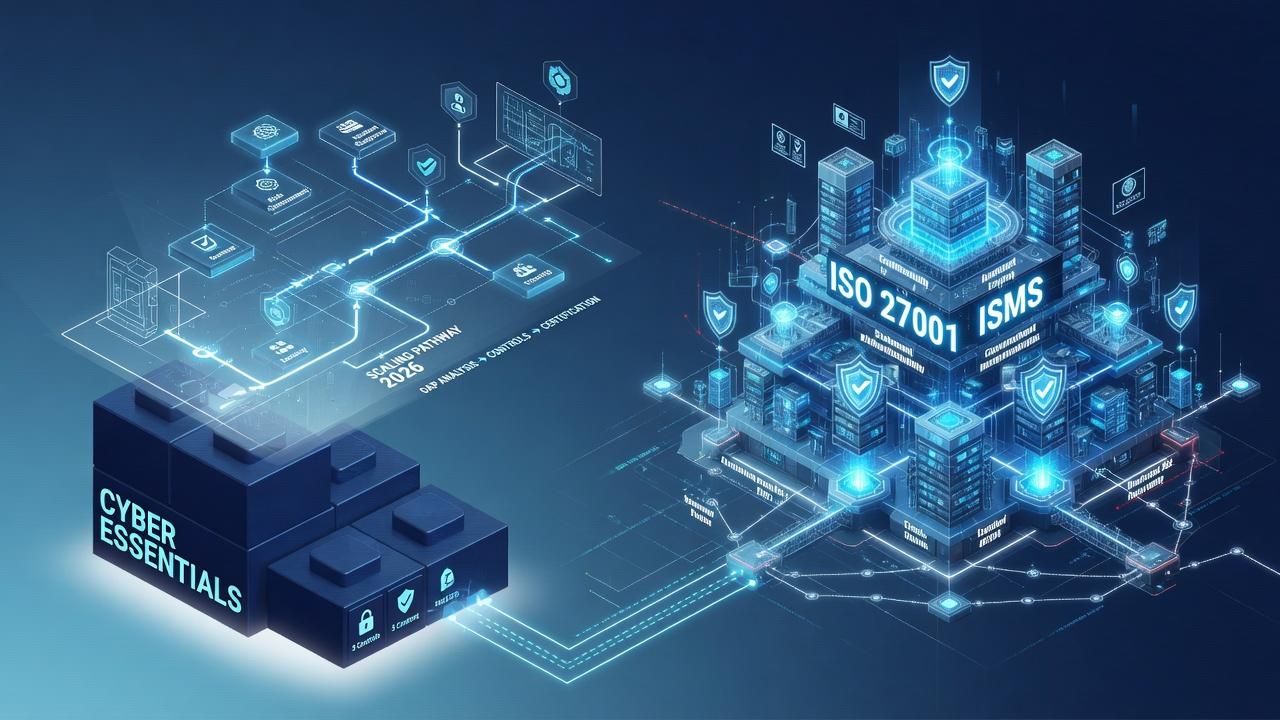
From Hygiene to Governance: How to Scale Cyber Essentials into a Full ISO 27001 ISMS in 2026
Discover how to scale Cyber Essentials into a full ISO 27001 ISMS in 2026. Reuse evidence, map controls, meet DORA & NIS2 rules and win enterprise contracts.

CIS Controls v8.1 Metrics That Matter: KPIs, KRIs, and Dashboards for Board-Ready Cyber Reporting
Quantify CIS Controls v8.1 success with KPIs, KRIs & dashboards. Learn what to measure, calculations, and executive presentations linking security to business r
Run Maturity Assessments with GRADUM
Transform your compliance journey with our AI-powered assessment platform
Assess your organization's maturity across multiple standards and regulations including ISO 27001, DORA, NIS2, NIST, GDPR, and hundreds more. Get actionable insights and track your progress with collaborative, AI-powered evaluations.
Explore More Comparisons
See how ISO 27001 and ISO 30301 compare against other standards