
OSHA vs CMMI
OSHA
US federal regulation for workplace safety standards
CMMI
Global framework for process maturity and improvement
Quick Verdict
OSHA enforces mandatory workplace safety regulations across US industries via inspections and fines, while CMMI provides voluntary process maturity frameworks for software/services globally through appraisals. Companies adopt OSHA for legal compliance; CMMI for performance gains.
OSHA
Occupational Safety and Health Act of 1970
Key Features
- Enforces General Duty Clause for recognized hazards
- Mandates hierarchy of controls prioritizing engineering
- Codified standards in 29 CFR 1910 subparts
- Risk-based inspections and civil penalties
- Mandatory OSHA 300 injury recordkeeping and reporting
CMMI
Capability Maturity Model Integration (CMMI)
Key Features
- Maturity levels 0-5 for organizational progression
- Practice Areas across multiple domains
- Staged and continuous representations
- Institutionalization practices for process persistence
- Benchmark appraisals for official maturity ratings
Detailed Analysis
A comprehensive look at the specific requirements, scope, and impact of each standard.
OSHA Details
What It Is
Occupational Safety and Health Act of 1970 (OSH Act) establishes OSHA as the U.S. federal agency enforcing workplace safety via 29 CFR 1910 standards for general industry. Its purpose is assuring safe conditions by reducing hazards through standards enforcement, inspections, and programs. Core approach: General Duty Clause (Section 5(a)(1)) mandates hazard-free workplaces; specific standards prevail where applicable.
Key Components
- Organized into subparts (A-Z) covering walking surfaces, PPE, HazCom, LOTO, toxic substances.
- Hierarchy of controls elimination, substitution, engineering, administrative, PPE.
- Recordkeeping (OSHA 300/300A/301), electronic ITA submission.
- Performance-based with penalties exceeding $171k for willful violations.
Why Organizations Use It
Legal compliance avoids fines, inspections; reduces injuries, costs via prevention. Enhances reputation, insurance rates, worker retention. Strategic for high-hazard industries.
Implementation Overview
Phased: gap analysis, written programs (IIPP), training, audits. Applies to most U.S. private employers; state plans may enhance. No certification, but ongoing enforcement via inspections.
CMMI Details
What It Is
Capability Maturity Model Integration (CMMI) is a performance improvement framework governed by ISACA's CMMI Institute, originating from the Software Engineering Institute. It focuses on institutionalizing processes for predictable delivery in development, services, and acquisition using maturity and capability levels.
Key Components
- Maturity Levels 0-5 Progress from incomplete to optimizing via staged representation.
- Practice Areas Organized by domains in V3.0 (e.g., Development, Services, Data).
- Institutionalization Ensures persistence (policy, planning, monitoring).
- Appraisals Benchmark, Sustainment, and Evaluation appraisals.
Why Organizations Use It
- Enhances predictability, reduces rework, improves quality.
- Meets contractual requirements (e.g., DoD).
- Drives ROI through data-driven management.
- Builds trust via published maturity ratings.
Implementation Overview
- Phased: gap analysis, piloting, training, rollout, appraisal.
- Applies to mid-large orgs in IT, software, defense.
- Tailorable for Agile/DevOps; requires evidence-based audits.
Key Differences
| Aspect | OSHA | CMMI |
|---|---|---|
| Scope | Workplace safety, health standards, enforcement | Process improvement, maturity levels, best practices |
| Industry | All US industries, general/construction | Software, IT, defense, services globally |
| Nature | Mandatory federal regulations, enforced | Voluntary process framework, appraised |
| Testing | Inspections, citations by OSHA officers | SCAMPI appraisals by certified teams |
| Penalties | Civil fines up to $165K, daily abatements | No penalties, loss of certification |
Scope
Industry
Nature
Testing
Penalties
Frequently Asked Questions
Common questions about OSHA and CMMI
OSHA FAQ
CMMI FAQ
You Might also be Interested in These Articles...

Top 10 Reasons CMMC Level 3 Certification Unlocks Competitive Edge for Primes Handling Critical DoD Programs
Discover top 10 reasons CMMC Level 3 certification unlocks competitive edge for DoD primes. Reduced APT risks, procurement prefs, NIST 800-172 compliance via v2

How to Implement CIS Controls v8.1 as a ‘Control Backbone’ for NIS2 & DORA (Step-by-Step Implementation Guide)
Deploy CIS Controls v8.1 as a control backbone for NIS2 & DORA compliance. Step-by-step roadmap (IG1→IG2), deliverables, metrics & evidence model for hybrid/clo
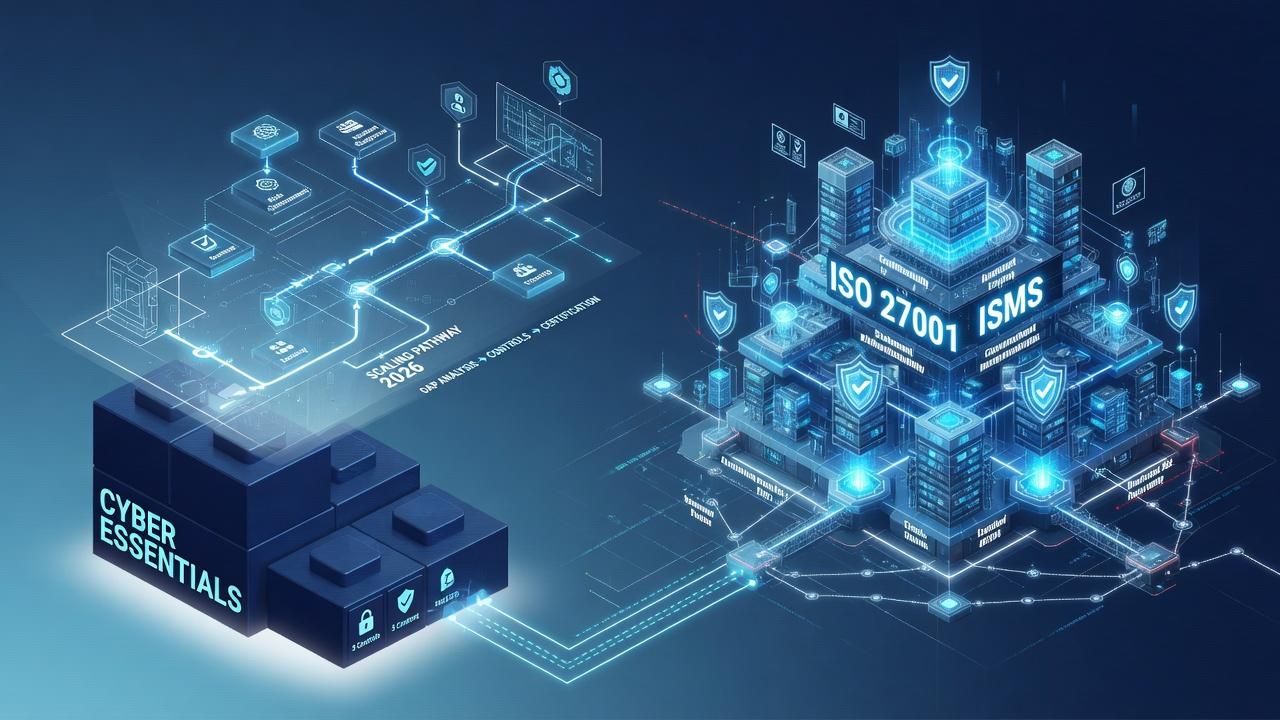
From Hygiene to Governance: How to Scale Cyber Essentials into a Full ISO 27001 ISMS in 2026
Discover how to scale Cyber Essentials into a full ISO 27001 ISMS in 2026. Reuse evidence, map controls, meet DORA & NIS2 rules and win enterprise contracts.
Run Maturity Assessments with GRADUM
Transform your compliance journey with our AI-powered assessment platform
Assess your organization's maturity across multiple standards and regulations including ISO 27001, DORA, NIS2, NIST, GDPR, and hundreds more. Get actionable insights and track your progress with collaborative, AI-powered evaluations.
Explore More Comparisons
See how OSHA and CMMI compare against other standards